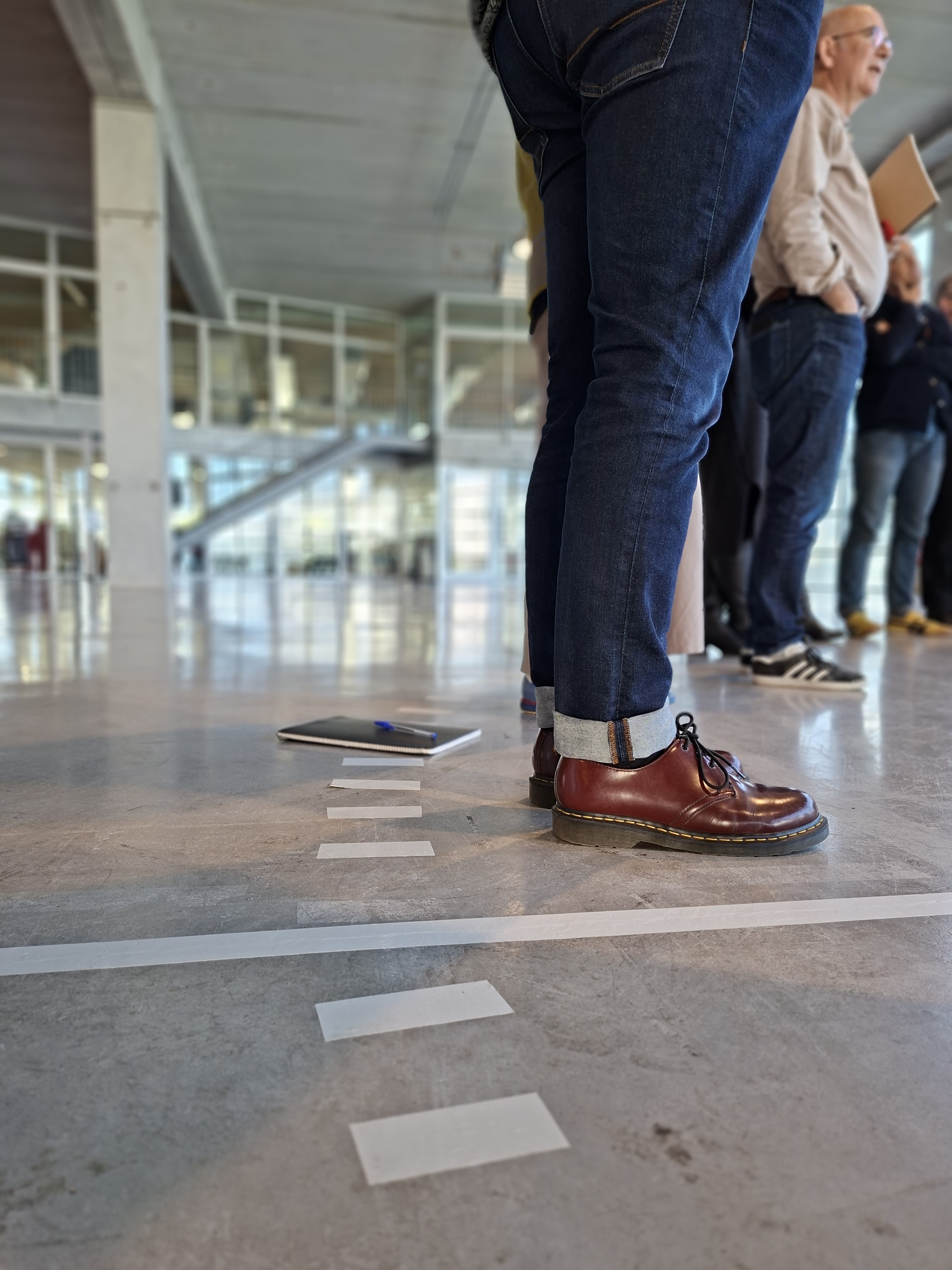
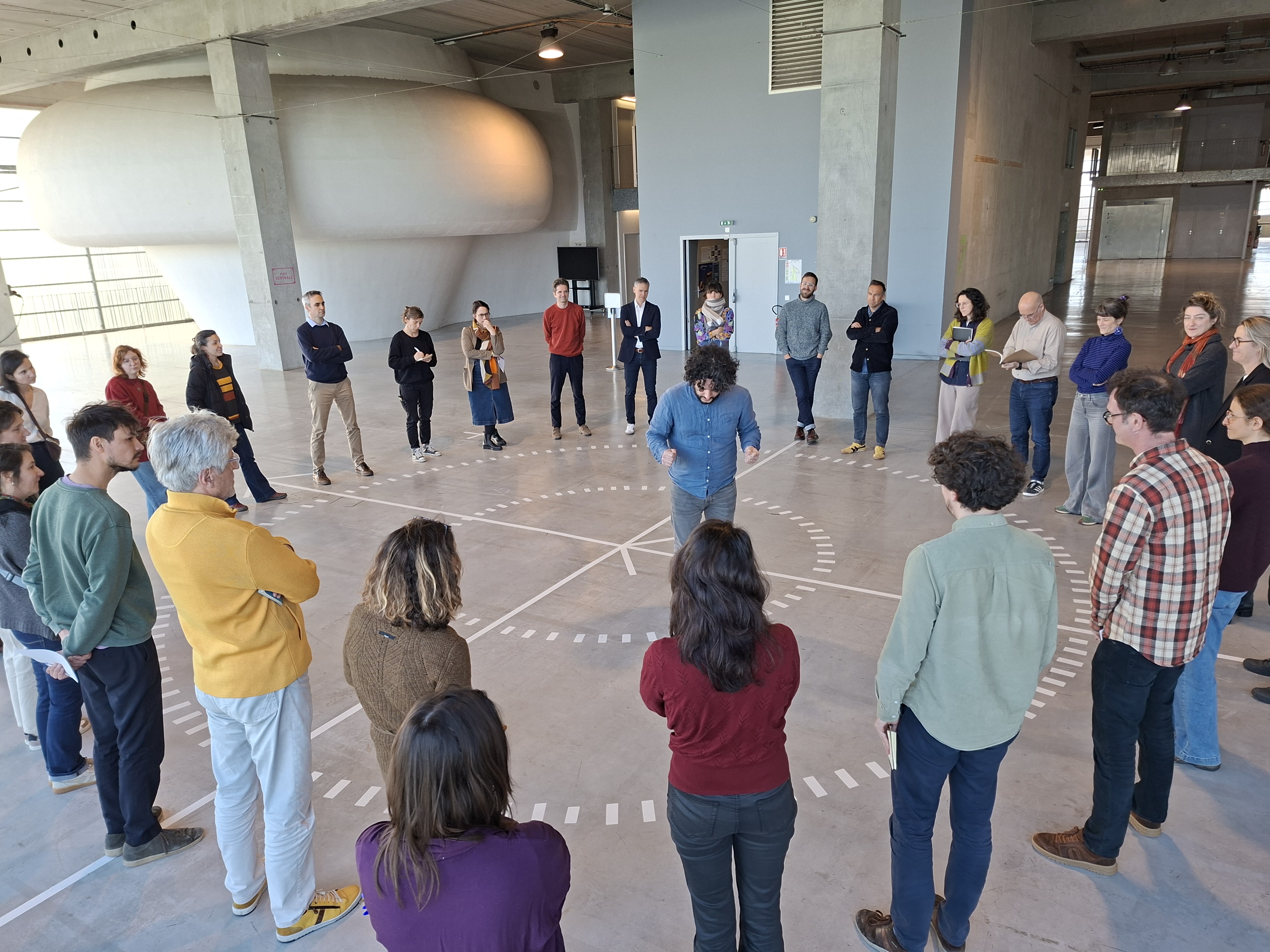
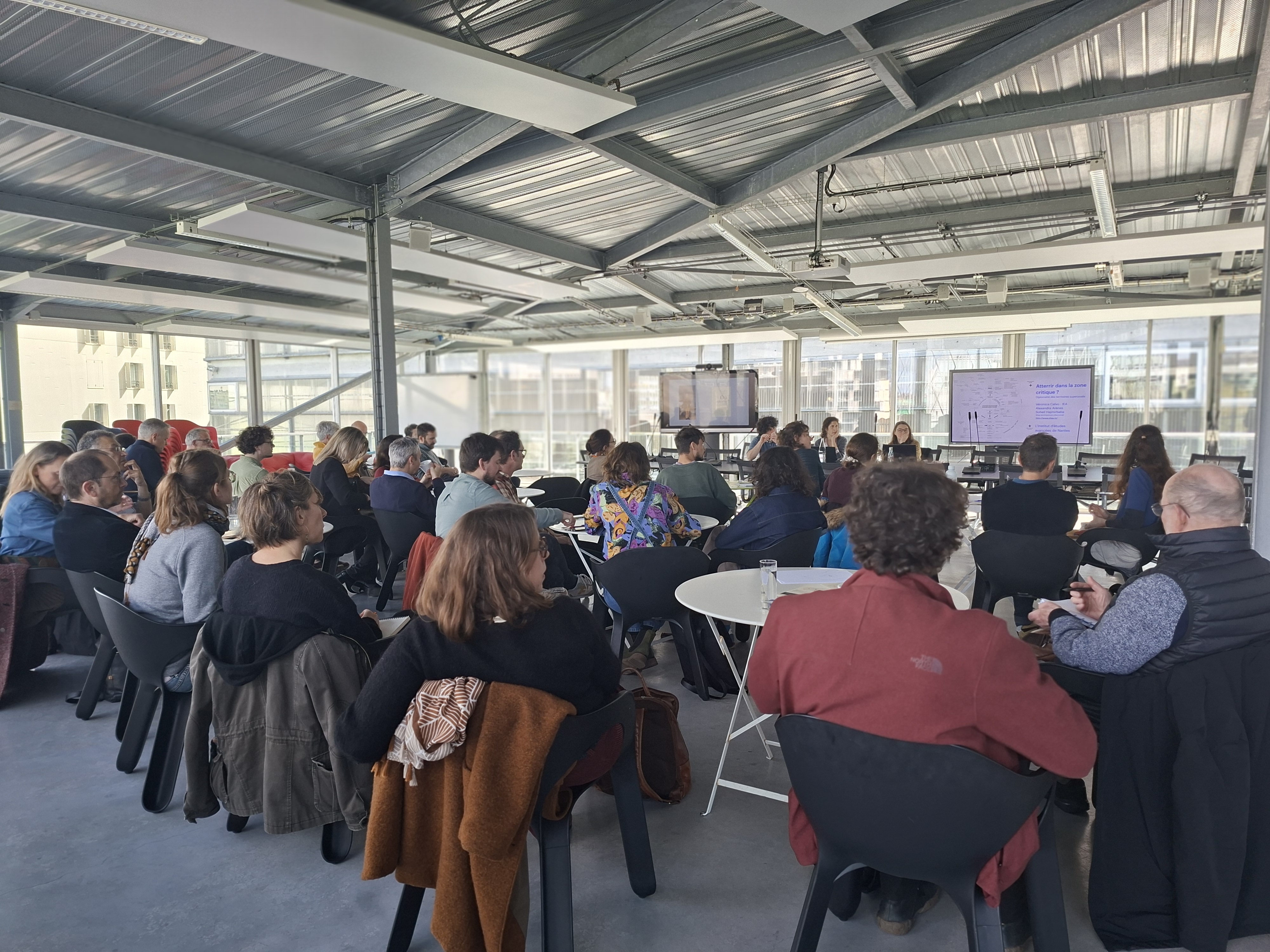
On March 30, 2026, at the Nantes School of Architecture (ENSA Nantes), around forty participants took part in the first session of the Dialogue series of the Living within Planetary Boundaries Chair. Organized in partnership with the Nantes Urban Planning Agency, ENSA Nantes, SCE-KERAN, and the Nantes Institute for Advanced Study, the event brought together Verónica Calvo Valenzuela, Alexandra Arène, and Soheil Hajmirbaba to explore new practices at the intersection of architecture, anthropology, and cartography.
Through a selection of photographs and intersecting perspectives—from a researcher in residence, a participating architect, and a partner of the chair—this reflection extends the day’s discussions and brings out resonances that are both nuanced and complementary.
A podcast of the event will soon be available in the May newsletter. A second Dialogue will take place on June 1, 2026, also at ENSA Nantes, followed by the Chair’s closing event on June 18, 2026, at the Nantes Institute for Advanced Study.

This first Chair Dialogue invited participants to reexamine the ways we describe and inhabit territories through the “Down to earth” approach. The three speakers helped us identify, in concrete terms, what we truly value. The aim is thus to describe a “living environment,” understood as a network of interdependent relationships between humans and non-humans, where plants, the elements—everything that makes up the Critical Zone—appear as full-fledged actors in territorial dynamics, whether social, economic, emotional, or geochemical.
It is therefore a matter of rethinking and reclaiming our attachments to territories so that we can redefine our place within them and our capacity for action. Each territory is revealed to be caught up in interdependent and interconnected issues that are both local and global.
The speakers thus proposed, as a practical tool for applying these theories, the self-description compass. Each participant, representing a different actor in the territory, identified their allies, opponents, and forms of action, in response to the following question: “Name one thing, one entity, one being, or one activity that, within the context of your projects, is threatened with extinction.”
Perspective from a Chair Partner
According to AURAN participants, this approach helps to repoliticize the ecological issue by emphasizing that environmental challenges are inextricably linked to collective and institutional decisions. It thus calls for a redefinition of our decision-making frameworks to ground them in the ecological and social realities of local communities, while revitalizing practices of consultation and collaborative decision-making. Finally, it underscores the fundamental need to take the time to understand local communities before seeking to transform them.
Perspective from a Workshop Participant
Margo Thilly-Soussan, architect, describes this workshop as a significant moment of reflection and experimentation. She highlights the richness of exchanges between stakeholders with sometimes divergent perspectives, and the value of using disagreement as a starting point to question practices and their impacts. She thus underscores a collective and interdisciplinary approach, where conflict becomes a lever for rethinking and designing the city differently—by learning to better understand and work together.
Perspective from a Researcher in Residence
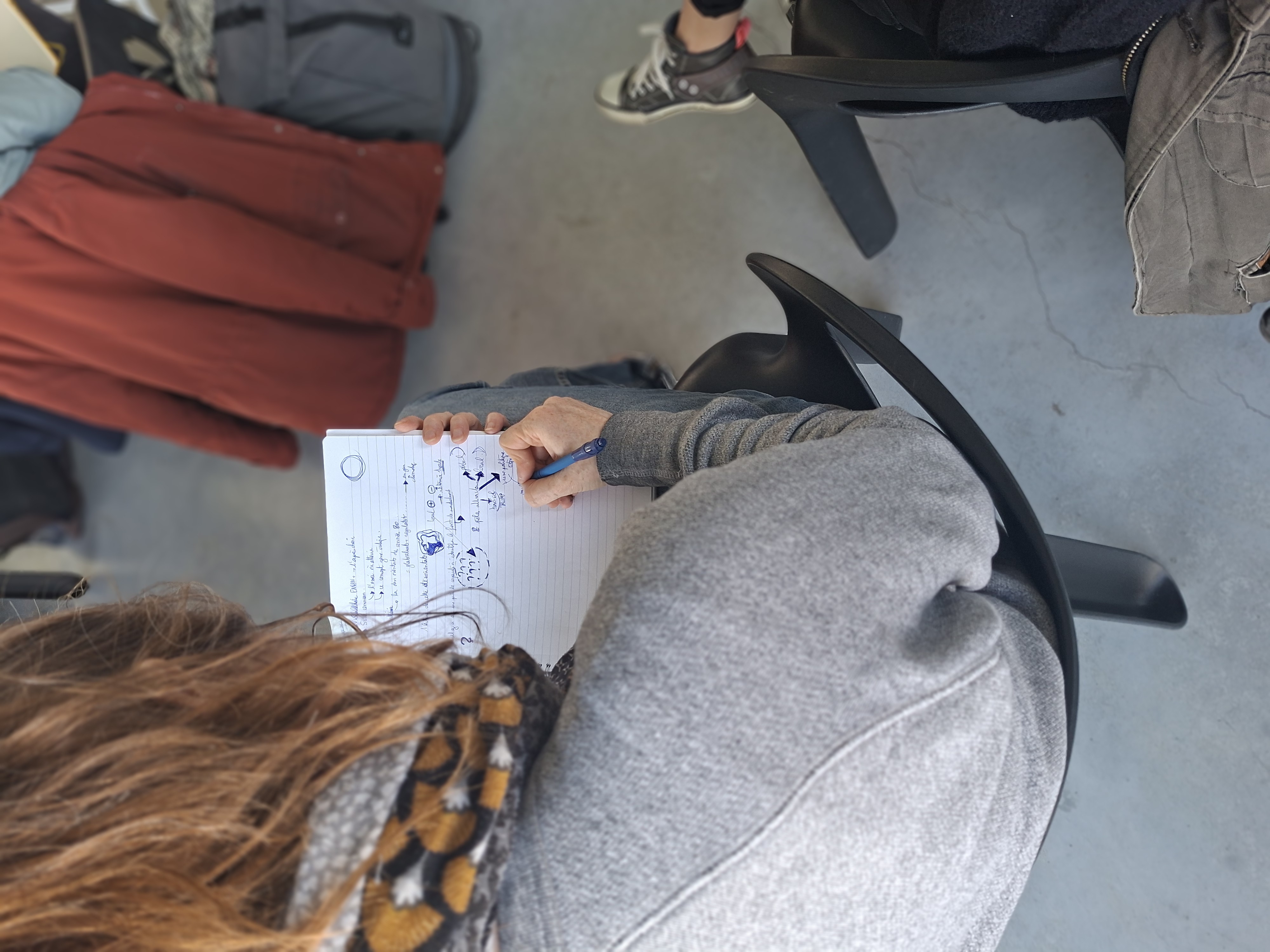
"I have a confession to make: when I go to a talk or a workshop, I sometimes try to think of a film, a work of literature, or some music that could conceivably serve as a backdrop or accompaniment. And so, it was tempting to link the themes of the workshop of March 30, 2026, to Adam McKay’s Don’t Look Up! (2021), where the Earth is destroyed by a comet whose point of impact (atterrissage) is unknown, or, in a less cheerful register, to Lars von Trier’s Melancholia (2011), where an asteroid has the same effect but with a far heavier mood. What came to mind instead was the striking opening scene of Mathieu Kassovitz’s La Haine, where a Molotov cocktail spirals earthwards as we hear the voice of the narrator: “This is a story about a man falling from a skyscraper fifty storeys high. On the way down he keeps saying, ‘So far, so good… So far, so good… So far, so good.’ But the fall is not important; only the landing matters.” At that very moment the Molotov cocktail lands and sets the screen on fire. After the landing and the explosion, we are left wondering: “Where do we go from here?”
The most prominent themes that emerged from this event are the Earth, or rather landing on Earth (atterrir) via Veronica Calvo Valenzuela’s magnificent presentation, and loss, as in the question posed by Alexandra Arenàs and Soheil HajmirBaba to the workshop participants: think of what it would mean to lost an object or a person and how it might change your behaviour. Combining the two, we could ask: What would it mean to lose the earth, or the world?
For Stanley Cavell, losing the world is what sceptics do, and the way around it is to reengage with the world in terms of acknowledgement rather than knowledge. And acknowledgement is precisely what all sceptics, including climate sceptics, refuse to do. One version of that scepticism is now on horrifying display in the form of the ongoing Iran war and the rather pointless debates about the Strait of Hormuz. As the war drags on, the realities of ecocide come into view in the form of petrol-laden rain in Tehran, scorched neighbourhoods everywhere from the Mediterranean to the Gulf, or the very real prospect of nuclear damage and its atrocious consequences. The world is experiencing its second major energy shock in under five years. It probably won’t be the last. Where do we go from here? Où atterrir? (Down to earth)
What would it mean to reengage with the world under these conditions? We can start by acknowledging the time we have lost. Time to meaningfully undertake the transition to green energy and greener practices. Time to ensure that the response to fewer hydrocarbons has to be more renewables, not coal. Time to mourn what have lost and are losing every day. Time to acknowledge our vulnerability and actually do something about it.